Review · 1985
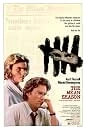
The Mean SeasonAmbition, Relevance, and the Addiction to Being Needed
My rating6/10
I threw The Mean Season (1985) on again after only reading the brief description on Tubi, so I came in with low expectations - and it instantly reminded me how many workplace crime thrillers lived in this lane in that era. The job isn't just a setting. It's the trap.
It's that same ecosystem as Blow Out (1981) - the professional who's supposed to stay behind the glass ends up pulled into the center of the mess. The same institutional gravity you feel in Absence of Malice (1981), All the President's Men (1976), even Network (1976). Not the same stories - just the same pressure. Your job becomes your identity, and your identity becomes your excuse.
In Blow Out (1981), Jack Terry (John Travolta) is a sound technician who catches something he can't un-hear. Here, Malcolm Anderson (Kurt Russell) is a reporter who's seen too much and keeps telling himself he's done with crime reporting - but he still moves through Miami like someone who can't quite leave the storm.
Kurt Russell (Malcolm Anderson) was in an interesting phase at this point - transitioning from his Disney and early television roots into harder-edged adult roles after films like Escape from New York (1981) and The Thing (1982). He carries that balance here: controlled, capable, but quietly restless.
I didn't expect much action, and there isn't much in the traditional sense. But when Malcolm makes it across the drawbridge just before it splits - that's always impressive in any context. Comedically or otherwise. There's something universally satisfying about beating a bridge.
The tension here is more psychological. Malcolm wants out of crime reporting. He's tired of the violence, tired of the grind. His girlfriend Christine Connelly (Mariel Hemingway, Manhattan (1979), Personal Best (1982)) wants him to leave Miami and reset. Clean break. New life. But when the serial killer starts calling him directly, giving him exclusives, Malcolm gets pulled back in.
Mariel Hemingway (Christine Connelly) was still closely associated with her Oscar- nominated turn in Manhattan (1979) at the time - often cast as the emotional counterweight to men spiraling in their own ambition.
The killer, Alan Delour (Richard Jordan, Dune (1984), The Hunt for Red October (1990)), doesn't just want to murder - he wants an audience.
And that's where the movie quietly sharpens. Delour isn't chasing chaos - he's chasing narrative control. He curates his crimes. He times his calls. He chooses Malcolm not because Malcolm is special, but because Malcolm is useful. The paper becomes a stage.
The headlines become amplification. Malcolm doesn't just report the violence - he helps frame it. And once he realizes he's the conduit, it's hard to pretend he isn't also part of the machinery.
Detective Ray Martinez (Andy Garcia, The Untouchables (1987), Black Rain (1989)) works the case from the law side. At the time, Garcia was still early in his rise - not yet the marquee name he'd become, but already carrying that sharp, coiled intensity that would define his late-'80s run.
You can feel how Malcolm's proximity to the investigation starts to flatter him. The access becomes currency.
It made me think about my own career in a strange way. Are you willing to shoot your big break in the face if it means keeping your sanity? Not literally. But if the thing that elevates you is also the thing that slowly consumes you, what do you do?
Christine wants him to walk away. And realistically, he could. He could just move. Not pick up the phone. Let another reporter take the calls. But Malcolm convinces himself the situation needs him. That he's the only one who can handle it. Is that true - or does he just like the rush? The relevance? The gravity of being "the guy" in the middle of it?
Joe Pantoliano (Andy Porter, Risky Business (1983), The Goonies (1985)) shows up and instantly makes scenes feel lived-in. In 1985 he was still building that résumé of sharp supporting turns that would later make him indispensable in crime dramas.
And yes - part of my brain will always see a flicker of Ralph Cifaretto from The Sopranos (1999-2007) behind his grin. Not because this character is the same - but because Pantoliano is that memorable. He can play morally slippery without losing your attention for a second. I genuinely wish the film gave him more runway.
What I appreciate most about The Mean Season isn't the violence. It's the ecosystem around it. Ambition. Access. Amplification. The way crime becomes performance once it has an audience.
It's not explosive. It's not glossy. It's not one of the era's defining classics.
First published on IMDb. Original IMDb review ↗