Review · 1993
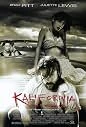
KaliforniaAwareness, Denial, and the Illusion of Control
My rating8/10
It's almost jarring to watch Early Grayce (Brad Pitt - Thelma & Louise (1991), Se7en (1995), Fight Club (1999)) knowing what Brad Pitt eventually becomes. Most actors carry their celebrity into every role - you can't unsee the superstar. But here, he disappears into something rough, volatile, and almost embarrassing in its lack of polish. It's crazy to think he's the one playing "white trash," and yet he sells it completely. You don't see a future movie star. You see Early - insecure, reactive, and quietly dangerous.
Juliette Lewis brings the same physical commitment to Adele Corners (Juliette Lewis - Cape Fear (1991), Natural Born Killers (1994)) that made her earlier performances so unsettling. She doesn't just act through dialogue; she acts through movement. Every posture shift, every glance, every burst of nervous energy feels lived-in. There's an innocence in her that clashes violently with the world she's in, and she makes that contradiction believable.
Brian Kessler (David Duchovny - The X-Files (1993-2002), Evolution (2001)) surprised me. His voiceover narration could have felt heavy-handed, but instead it works as mental checkpoints. It guides the story in a surprisingly pleasant way, giving structure to the tension without breaking immersion. It feels like you're in the backseat - observing rather than being instructed.
The first real crack in Early's charm comes during a quiet moment of intimacy between Brian and Carrie Laughlin (Michelle Forbes - The Killing Fields (1984), True Blood (2008- 2014)). The camera drifts past the wall, and instead of intimacy, we see Early watching. That's when you see it in his eyes - not curiosity, but calculation. The drifter stops feeling eccentric and starts feeling predatory.
What makes Kalifornia unsettling isn't just the violence - it's how deliberately every character is constructed as a sharp contrast to another.
The men are opposites. Brian is intellectual, analytical, convinced he understands darkness because he studies it. Early doesn't study darkness. He operates inside it. One believes knowledge equals control. The other proves control is an illusion.
The women are opposites as well. Carrie is perceptive and self-aware, reading danger before it fully surfaces. Adele senses it too, but processes it through loyalty rather than survival. One questions. The other clings.
The film keeps forcing these opposites into tight spaces - cars, motel rooms, roadside stops - until contrast becomes confrontation.
There's heavy irony threaded throughout. Brian continues framing events as research, as observation, insisting tensions are personal rather than situational long after reality has shifted beyond interpretation. Carrie sees the danger clearly. Brian keeps narrating.
Meanwhile, Adele spells out her swear words like a child trying to stay polite, while Early commits violence with startling indifference over something as small as pocket cash. The film doesn't dramatize evil as grand or theatrical. It shows how small the trigger can be. How ordinary the motive can feel.
The final stretch makes the entire road trip worth it. The escalation feels earned rather than sensational, and Pitt's performance belongs in the conversation whenever iconic on- screen psychopaths are discussed - even if it rarely gets mentioned that way. It's raw, physical, and completely unpolished in the best sense.
Every performance lands. No weak links. No tonal slips.
Kalifornia doesn't build toward shock.
First published on IMDb. Original IMDb review ↗