Review · 2012
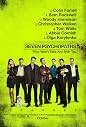
Seven Psychopaths - Chaos, Addiction, and Letting the Loudest Voice Win
My rating8/10
I admittedly didn't know much about Sam Rockwell going into this, but I do now. Other than his recent role in The White Lotus, I couldn't immediately place much of his work - maybe that's on me - but Billy Bickle (Sam Rockwell - Moon (2009), Three Billboards Outside Ebbing, Missouri (2017)) is pure controlled chaos. His energy matches the character perfectly. It never feels like he's trying to be crazy. It feels like he genuinely believes in whatever version of the story he's telling at that moment.
Hans Kieslowski (Christopher Walken - The Deer Hunter (1978), Catch Me If You Can (2002)) delivers another classic performance. He doesn't need to carry the movie. He fits it. His storyline with Myra (Linda Bright Clay), despite its darkness, makes you fall in love with him. No matter how psychotic he technically is - pun intended - there's a tenderness underneath. That humanity gives the film balance.
Marty Faranan (Colin Farrell - The Gentlemen (2019), Phone Booth (2002)) plays the bystander in a room full of louder personalities. He isn't the killer. He isn't the most violent. But I couldn't ignore how often his drinking is referenced. It's constant. His alcoholism sits in the background of almost every conversation. Even Charlie Costello (Woody Harrelson - Natural Born Killers (1994), No Country for Old Men (2007)) calls him out for drinking and driving. That line stuck with me.
The film treats alcohol almost like another weapon - normalized, joked about, but quietly destructive. That hit home. I've had moments in my own life where drinking felt casual, social, even harmless - until you look back and realize how close that line is to something permanent. The movie doesn't preach about it. It just shows how dysfunction can be dressed up as personality. Alcohol in this film feels just as toxic as the guns.
Charlie Costello is the perfect humorous villain. Harrelson balances rage and absurdity effortlessly. He's dangerous but funny, which somehow makes him more unsettling. It's a role I'd honestly like to see him in more - that slightly unhinged villain who still lands punchlines.
What I really appreciated was the creativity layered throughout the film. The characters are constantly pitching ideas, rewriting scenes, imagining alternate endings. The desert campsite scene is the best example. Billy starts painting this huge, over-the-top shootout with dramatic music, slow motion, everyone dying in a blaze of glory. And the way he describes it - with almost childlike excitement - you can see how much he loves storytelling. He's fully inside his imagination.
There's something refreshing about watching grown men light up over ideas like that. They're genuinely excited to build something in their heads. And the fact that all of that enthusiasm exists inside such a dark world - murder, revenge, violence - is the perfect contrast. It's playful and morbid at the same time.
The ending stood out to me too. When Billy says the movie ends the way he wants, it feels like more than just a meta joke. It feels like a commentary on how dynamics work. Sometimes the loudest person in the room shapes the outcome - not because they're right, but because they refuse to let go of their version. The quieter person, even if they technically "own" the story, ends up going along with it. Marty is the writer, yet Billy's louder vision dominates.
That makes sense to me. In real life, the loudest voice often wins simply because it exhausts everyone else. It isn't always about logic. It's about force of personality.
Seven Psychopaths balances absurdity, addiction, violence, and imagination without collapsing under its own cleverness.
It isn't just about psychopaths.
It's about creativity living next to destruction - and how easily chaos becomes normal when you're comfortable around it.
First published on IMDb. Original IMDb review ↗